Harvest guide
When to Harvest Cauliflower (Signs It's Ready)
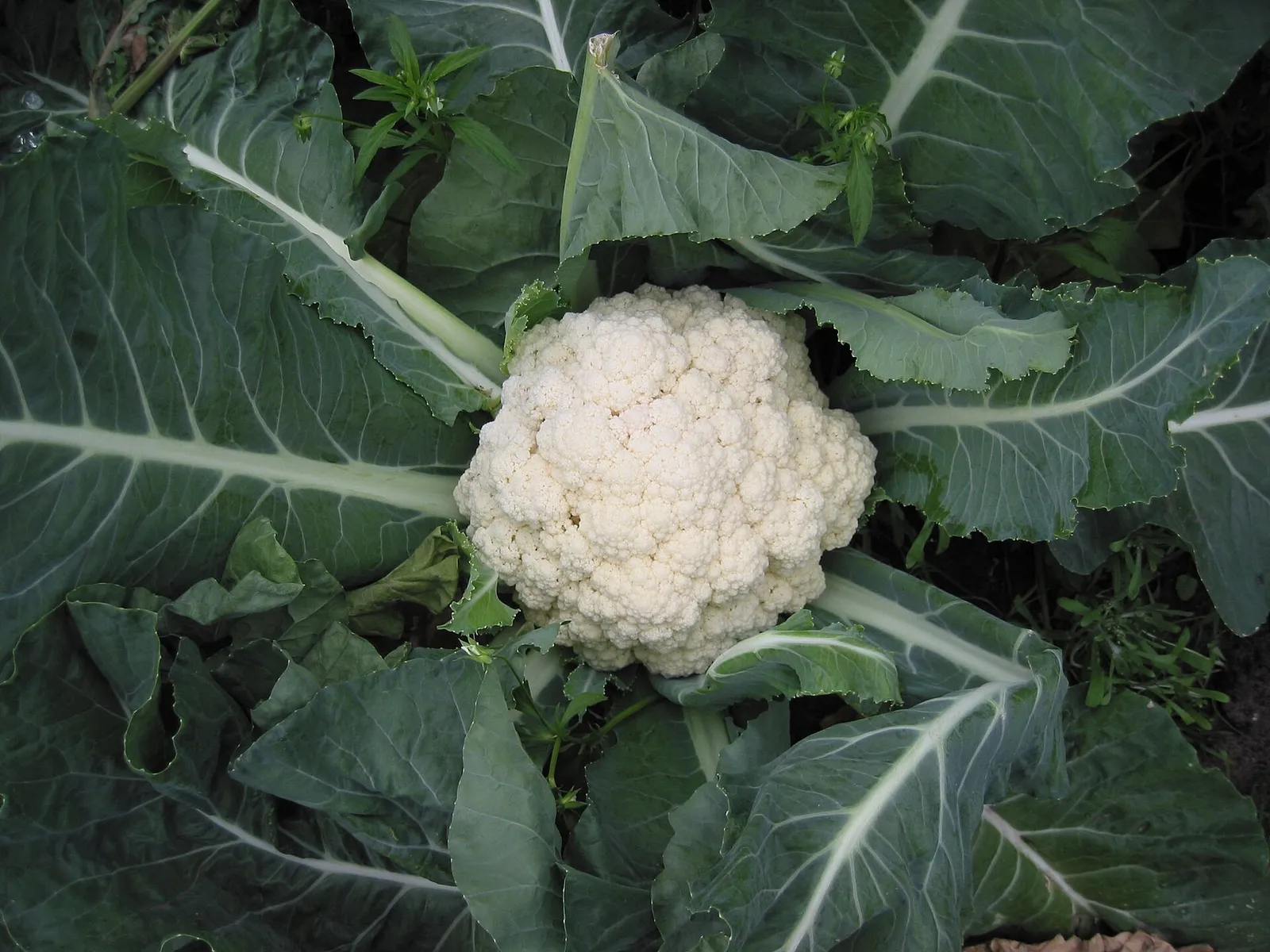
Cauliflower is ready about 55 to 100 days after planting, when the head is full, firm, compact, and about 6 to 8 inches across, before the curds loosen and separate. White types usually need blanching. Here are the cues.
Days to maturity
55–100days
Ready when
Compact white head before it separates
The short answer
Cauliflower is ready about 55 to 100 days after planting, when the head (the curd) is full, firm, compact, and about 6 to 8 inches across, before the curds loosen and separate. Cut the whole head with a few wrapper leaves. White types usually need blanching, so tie the outer leaves over the head once it is egg-sized.
The harvest window above comes from the days-to-maturity range for cauliflower. The rest of this guide is how to read the head, when to blanch, and how to cut and store it.
Days to maturity by type
The "right day" depends on the variety and the season. Early types finish fast. Late and fall types take longer.
Use these as windows, not deadlines. Iowa State Extension puts early cultivars at 50 to 60 days after planting and late cultivars at 70 to 80 days. Maryland Extension lists 50 to 80 days from transplanting. Utah State Extension names varieties from 50 days (Snow Crown) up to about 80 days (Denali for fall).
| Cauliflower type | Days to maturity | Head size at harvest |
|---|---|---|
| Early (e.g. Snow Crown) | 50–60 | 6–8 in |
| Mid-season | 60–70 | 6–8 in |
| Late / fall (e.g. Denali) | 70–100 | 6–8 in |
The day count on your packet starts the clock. Once a head forms, the head itself tells you the truth, not the calendar.
How to tell it's ready
Watch the curd, the white dome in the center of the plant. You want it caught right at full size and still tight.
Check these before you cut:
- Size. A mature head is about 6 to 8 inches across, per Iowa State and Illinois Extension. Utah State allows up to 6 to 12 inches on some varieties.
- Firm and compact. It should feel solid and dense, not soft or springy. Maryland Extension calls the ready curd compact, firm, white, and fairly smooth.
- Smooth surface. The top should be even and tight, like a single dome.
- Before it separates. Cut while the curd is still one tight mass. The moment it starts to loosen, get grainy, or show separate bumps and florets, you have waited too long.
Iowa State Extension is blunt about the late side. Over-mature heads begin to open up and become ricey. Illinois Extension adds that once individual florets can be seen, quality deteriorates rapidly. Cut a touch early before a touch late.
Blanching white cauliflower
Blanching is the one step that makes cauliflower different from broccoli or cabbage. It is not about taste. It is about keeping a white head white.
Sunlight on a developing white head turns it yellow, off-color, and can make it bitter. The fix is to tie the outer leaves up over the head so they shade it.
Start when the head is small. Maryland and Illinois Extension say to begin when the head is about 2 to 3 inches across, roughly egg to tennis-ball size. Utah State times it at about silver-dollar size. Pull the outer leaves up over the curd and tie them loosely with twine, a rubber band, or a cloth strip.
Then wait a short stretch. Maryland Extension puts blanching at 4 to 8 days in cool weather, longer in fall. Iowa State says the head is usually ready 1 to 2 weeks after tying. In warm weather, loosen the ties now and then so air can move and the head does not rot.
Not every type needs this. Self-blanching varieties have leaves that naturally curl up over the head, so tying is optional. And colored types skip blanching entirely. Iowa State notes that green, purple, or orange cultivars do not require blanching, since the color is the whole point.
Pro tip
Blanch when the head is egg-sized, about 2 to 3 inches across. Tie too early and the curd has no room to grow. Tie too late and the sun has already yellowed it. Mark the date you tied, then start checking the head a week later.
How to harvest and store cauliflower
Cut, do not pull. The head sits on a thick main stem, and you want a clean cut with some protection left on the curd.
Harvest like this:
- Cut below the head. Slice through the main stem just under the curd. Illinois Extension says to cut the main stem and leave a few green outer leaves attached to protect the head.
- Keep a ruff of leaves. Maryland Extension recommends leaving a ruff of wrapper leaves around the head to prolong keeping quality.
- Cut in the morning. Harvest while the head is cool and firm, before the day heats up.
Then store it cold and humid. Iowa State Extension holds cauliflower in perforated plastic bags in the refrigerator for 2 to 4 weeks. Utah State stores it for about 3 weeks at 32°F. Maryland keeps it in very cold, moist conditions at 95% humidity for 2 to 4 weeks.
One thing to plan for: the plant is done after one head. Illinois Extension notes that cauliflower does not ordinarily develop side shoots, so unlike broccoli it will not give you a second flush worth picking. A few plants may push out tiny shoots, but do not count on them. Pull the plant and use the space.
Common mistake
Two mistakes ruin a cauliflower head. Waiting too long lets the tight curd loosen, go ricey and grainy, and turn bitter, and Illinois Extension says quality drops fast once florets show. Skipping blanching on a white variety leaves the head yellowed and off-color from the sun. Check sizing heads daily, and tie the leaves on white types before the sun gets to them.
Get the spacing right next year
Crowded cauliflower makes small, loose, disappointing heads. The plants are heavy feeders that need room and steady water to size up a tight curd. Give each one space and you get full 6 to 8 inch heads instead of buttoned-up little ones.
The fix is spacing. Set cauliflower about 18 inches apart in the row, with rows about 24 inches apart. The plant spacing chart has the full crop list, and the Plant Spacing Calculator shows how many fit your bed.
Try it — Plant Spacing Calculator
Full calculatorExtra to cover losses (10% is typical).
You can plant
32plants
- Per row
- 8
- Rows
- 4
- Buy (incl. spare)
- 36 plants
Cauliflower shares a bed and a rhythm with its brassica cousins. The same firm-head test runs when to harvest cabbage, and steady cutting keeps when to harvest kale going for months.
Your next step
Cauliflower is ready when the head is firm, compact, smooth, and about 6 to 8 inches across, somewhere in the 55 to 100 day window, and before it loosens or goes ricey. Blanch white types at egg size, cut below the head with a few leaves on, and store it cold.
Planning next season's bed? Open the Plant Spacing Calculator and set cauliflower at 18 inches so every plant has room for a full head.
Common questions
How do I know when cauliflower is ready to pick?
Look at the head, called the curd. It is ready when it is full, firm, compact, smooth, and about 6 to 8 inches across, before the surface starts to loosen and separate into bumps. Iowa State Extension says to harvest when heads are smooth, firm, and compact, and that over-mature heads begin to open up and turn ricey. When in doubt, cut a little early rather than late.
Do I have to blanch cauliflower?
Only white types, and only if you want them snow white. Blanching means tying the outer leaves over the head to keep sunlight off it. Maryland and Illinois Extension say to tie the leaves once the head is about 2 to 3 inches across, roughly egg to tennis-ball size. Self-blanching varieties and colored types (purple, orange, green) do not need it, since their leaves curl over on their own or the color is the point.
Will cauliflower grow back after I cut the head?
No. Unlike broccoli, cauliflower does not regrow a main head and does not make a useful flush of side shoots. Illinois Extension notes that cauliflower does not ordinarily develop side shoots, so the plant is done after the one head. Pull it and plant something else.
What happens if I wait too long to harvest cauliflower?
The head goes past its prime fast. The tight curd loosens, the surface gets grainy or ricey, individual florets start to show, and the flavor turns bitter. Illinois Extension says once individual florets can be seen, quality deteriorates rapidly. Check daily once a head is sizing up.
How long does harvested cauliflower keep?
Stored cold and humid, a few weeks. Iowa State Extension keeps cauliflower in perforated plastic bags in the refrigerator for 2 to 4 weeks, and Utah State stores it for about 3 weeks at 32°F. Leave a few wrapper leaves on to protect the curd until you use it.
Sources
Agronomic claims in this guide are checked against these primary sources.
- Growing Cauliflower in the Home Garden — Iowa State University Extension and Outreach
- Growing Cauliflower in a Home Garden — University of Maryland Extension
- Cauliflower — University of Illinois Extension
- How to Grow Cauliflower in Your Garden — Utah State University Extension
Keep reading
When to Harvest Broccoli (Signs It's Ready)
Broccoli is ready about 60 to 90 days after planting, when the central head is 4 to 7 inches across with tight, dark-green buds, before any open to yellow. Here are the cues, the cut, and the weeks of side shoots that follow.
Read →When to Harvest Cabbage (Signs It's Ready)
Cabbage is ready about 70 to 100 days after transplanting, when the head feels firm and solid as you squeeze it and has reached full size for the variety. Cut it before it splits.
Read →When to Harvest Kale (Signs It's Ready)
Kale is ready about 50 to 65 days after sowing for full leaves, or about 25 to 30 days for baby leaves. Pick the outer leaves from the bottom up, leave the central bud, and the plant keeps producing for months.
Read →When to Plant Zucchini (Frost + Soil Temp Timing)
Plant zucchini after your last spring frost, once the soil hits at least 60 F (ideally 65 to 70 F). Direct-sow seeds 1/2 to 1 inch deep, or set out transplants started 2 to 4 weeks earlier. Warm zones get a second fall crop.
Read →When to Plant Tomatoes (Frost + Soil Temp by Zone)
Set tomato transplants out 1 to 2 weeks after your last spring frost, once soil hits at least 60 F. Start seeds indoors 6 to 8 weeks before that frost date. Cold soil stalls them, so wait for warmth.
Read →When to Plant Swiss Chard (Spring and Fall Timing)
Plant swiss chard 2 to 4 weeks before your last spring frost, once the soil hits 40°F. Sow again 3 to 4 weeks before the first fall frost. Seeds go half an inch to an inch deep.
Read →