Harvest guide
When to Harvest Radishes (Signs They're Ready)
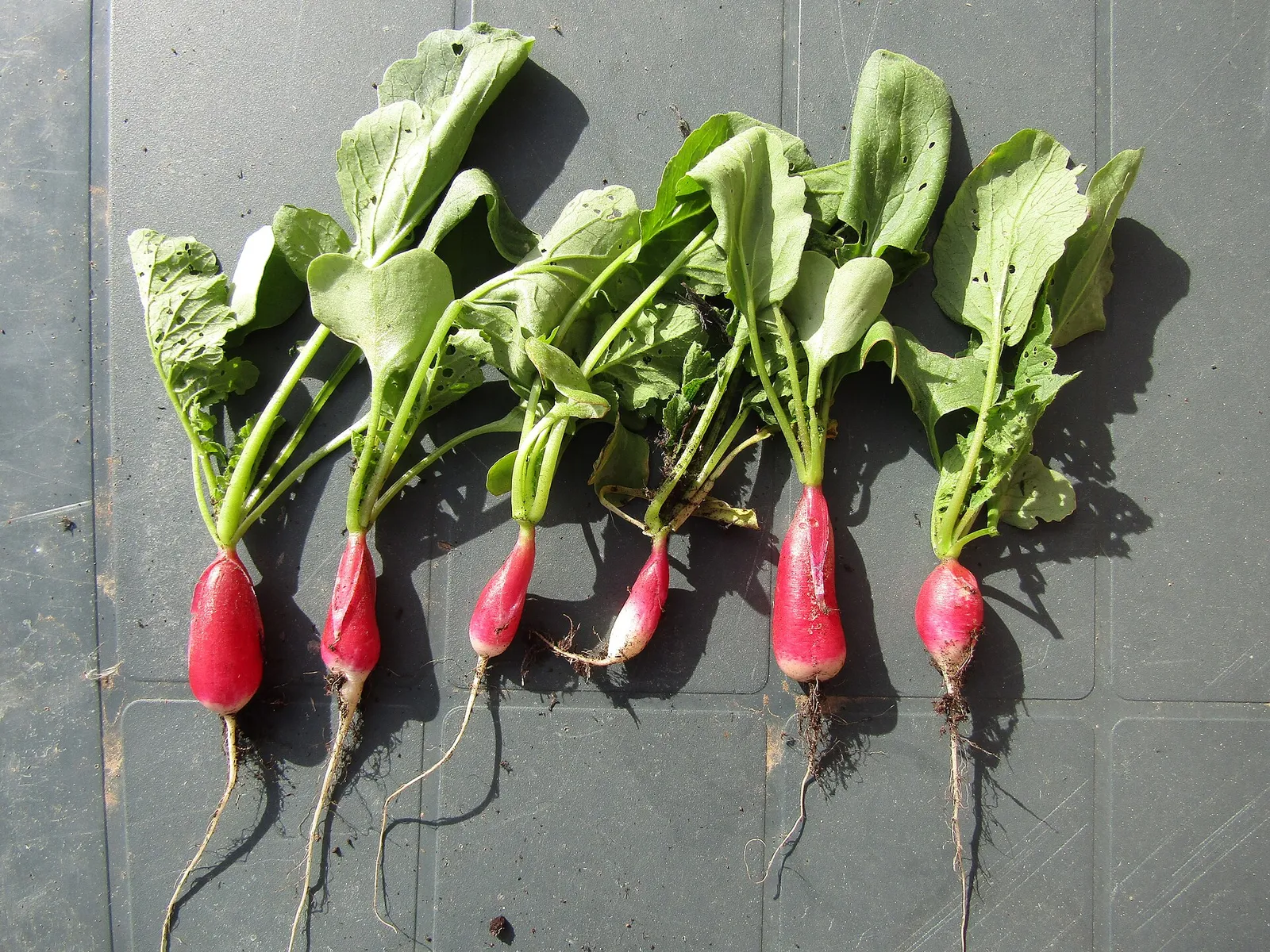
Salad radishes are ready fast, about 22 to 35 days after sowing, when the root is roughly 1 inch across at the soil line. Pull promptly, check the shoulder, and learn how daikon and winter types differ.
Days to maturity
22–35days
Ready when
Root ~1in across; pull promptly to avoid woodiness
The short answer
Salad radishes are ready fast, about 22 to 35 days after sowing, when the root is roughly 1 inch across at the soil line. Pull them promptly. Left in warm ground they turn woody, pithy, and unpleasantly hot. Brush back the soil to check the shoulder, or do a quick test pull.
The harvest window above comes from the days-to-maturity range for salad radishes. The rest of this guide is how to read the cues, pull them clean, and why waiting costs you.
Type and timing
Not all radishes finish on the same clock. Round salad radishes and French breakfast types race to maturity. Daikon and winter radishes take weeks longer and grow much bigger.
University of Minnesota Extension and Iowa State Extension both put spring radishes at three to five weeks, which is about 22 to 35 days. Iowa State lists daikon at 50 to 60 days.
| Radish type | Ready size | Days to maturity |
|---|---|---|
| Round salad (Cherry Belle, etc.) | About 1 inch across | 22–35 |
| French breakfast | About 1 inch across, oblong | 22–35 |
| Daikon / winter | 1–2 inches across, 8+ inches long | 50–60 |
Treat the day count as the start of the window, not a deadline. Cool, even moisture keeps salad radishes in good shape a little longer. Heat shortens the window fast.
How to tell they're ready
The calendar gets you close. The shoulder tells you the truth.
Check three things before you pull the whole row:
- Shoulder at the soil line. Brush the soil off the top of one root and look at the crown. Salad radishes are ready at about 1 inch across. Illinois Extension says to pick spring radishes when roots are less than 1 inch in diameter and still small and tender.
- Days since sowing. Salad types land in the 22 to 35 day window. If you sowed three weeks ago, start checking.
- A test pull. Iowa State Extension says to check development by pulling one or two plants as they near maturity. If the first one is firm and about 1 inch, the rest are ready.
With radishes there is no penalty for pulling one early to look. Seed is cheap and the crop is fast.
How to harvest radishes
Salad radishes come out with your hand. There is no fork involved for the small round types.
- Grasp the base of the tops. Pinch the leaves right where they meet the root and pull straight up. The root slides out clean in loose soil.
- Water first if the ground is dry. Damp soil releases the root more easily and keeps the top from snapping off.
- Loosen daikon with a fork. Long winter roots break if you yank them. Iowa State says to dig with a spade or garden fork once daikon reaches mature size, and UMN says to spade or fork underneath to lift long roots without breaking them.
Work the row a section at a time. Pull the biggest shoulders first and leave the smaller ones a few more days.
Why prompt pulling matters
A radish at peak is crisp, mild, and clean. A radish left too long is a different vegetable.
Iowa State Extension says radishes get pithy and hot when harvested too late, and that in the warm temperatures of summer they turn spongy, woody, and excessively hot and run to seed. Illinois Extension warns that oversize summer radishes can become tough, wooden, and hollow. None of that reverses. Once a salad radish goes pithy, you pull it for the compost.
The fix is to harvest on time and to sow in waves. Iowa State suggests sowing seed every 7 to 10 days so a few roots come ready each week instead of the whole bed at once. Illinois Extension makes the same point with short rows every 10 to 14 days.
For storage, cut the tops first. Iowa State says trim the foliage to within about 1/2 inch of the roots, then refrigerate for 2 to 3 weeks. Salad radishes do not keep long, so plan to eat them within a couple of weeks. Winter radishes hold a bit longer in cold storage.
Common mistake
Two ways a radish crop disappoints. Leaving them too long is the big one. Past about 1 inch, salad radishes go woody, pithy, and hot, and Iowa State notes they readily run to seed in summer heat. The other is all leaf and no root. Too much nitrogen pushes top growth, and heat does the same, since radishes are a cool-season crop. Go easy on high-nitrogen feed and sow in the cool of spring and fall.
Pro tip
Sow a short row every 1 to 2 weeks instead of one big planting. Iowa State suggests every 7 to 10 days, Illinois every 10 to 14. You get a steady trickle of crisp radishes at peak, and nothing sits in the ground long enough to turn woody. A foot of row at a time is plenty for most kitchens.
Get the spacing right
Crowded radishes never size up to a clean 1 inch shoulder. They stay thin and stringy and read as "not ready" when really they are just starved for room.
The fix is spacing. Thin salad radishes to about 1 to 2 inches apart in the row so each one has space to swell. The plant spacing chart has the full crop list, and the Plant Spacing Calculator shows how many fit your bed.
Try it — Plant Spacing Calculator
Full calculatorExtra to cover losses (10% is typical).
You can plant
32plants
- Per row
- 8
- Rows
- 4
- Buy (incl. spare)
- 36 plants
Radishes are one quick crop in a cool-season bed. The same shoulder-at-the-soil-line check works for roots like when to harvest carrots, and cut-and-come-again timing matters more for when to harvest lettuce.
Your next step
Salad radishes are ready when the shoulder hits about 1 inch at the soil line, somewhere in the 22 to 35 day window. Brush back the soil, do a test pull, and grasp the base of the tops to lift them clean. Pull promptly so they never turn woody.
Planning the next round? Open the Plant Spacing Calculator and set your radishes so each one has room to size up.
Common questions
How do I know when radishes are ready to pick?
Brush the soil away from the top of a root and look at the shoulder, the widest part at the crown. Salad radishes are ready when that shoulder is about 1 inch across, which lands roughly 22 to 35 days after sowing. Iowa State Extension says to harvest once roots reach usable size, about 1 inch in diameter, and to check by pulling one or two as they near maturity.
Can you leave radishes in the ground too long?
Yes, and they go downhill fast. Iowa State Extension says radishes get pithy and hot when harvested too late, and become spongy, woody, and excessively hot in the warm temperatures of summer. Illinois Extension adds that oversize summer radishes can turn tough, wooden, and hollow. Pull salad radishes promptly once they hit about 1 inch.
How long do radishes take to grow?
Salad radishes are one of the fastest crops you can grow. University of Minnesota Extension and Iowa State Extension both put them at three to five weeks, or about 22 to 35 days, after planting. Daikon and other winter radishes are slower. Iowa State lists daikon at about 50 to 60 days.
Why are my radishes all leaves and no root?
Two common causes. Too much nitrogen pushes leafy top growth at the expense of the root, so go easy on high-nitrogen feed. And heat is a problem, since radishes are a cool-season crop. Illinois Extension notes radishes do poorly in hot weather, so sow in the cool of spring and fall rather than midsummer.
How do you store radishes after harvest?
Cut the tops off first. Iowa State Extension says to trim the foliage to within about 1/2 inch of the roots, then refrigerate for 2 to 3 weeks. Illinois Extension stores spring radishes wrapped in plastic bags for 5 to 7 days. Winter radishes keep longer, up to about two weeks in the fridge.
Sources
Agronomic claims in this guide are checked against these primary sources.
- Growing radishes in home gardens — University of Minnesota Extension
- Growing Radishes in Iowa — Iowa State University Extension and Outreach
- When should radishes be harvested? — Iowa State University Extension and Outreach
- Radish — University of Illinois Extension
Keep reading
When to Harvest Carrots (Signs They're Ready)
Carrots are ready about 50 to 80 days after sowing, when the shoulder is roughly 1/2 to 3/4 inch across at the soil line. Here are the cues, the lift-don't-yank method, and how to store them.
Read →When to Harvest Beets (Size + Signs)
Beets are ready about 50 to 70 days after sowing, when the root shoulder is roughly 1.5 to 3 inches across at the soil line. Here are the size cues, the lift-and-twist method, and how to store the roots and the greens.
Read →When to Harvest Lettuce (Leaf + Head Types)
Lettuce is ready about 30 to 60 days after sowing. Pick the outer leaves of leaf types as soon as they are 3 to 4 inches, and cut head types when they are full and firm. Here are the cues, the cut-and-come-again trick, and how to beat the bolt.
Read →When to Plant Zucchini (Frost + Soil Temp Timing)
Plant zucchini after your last spring frost, once the soil hits at least 60 F (ideally 65 to 70 F). Direct-sow seeds 1/2 to 1 inch deep, or set out transplants started 2 to 4 weeks earlier. Warm zones get a second fall crop.
Read →When to Plant Tomatoes (Frost + Soil Temp by Zone)
Set tomato transplants out 1 to 2 weeks after your last spring frost, once soil hits at least 60 F. Start seeds indoors 6 to 8 weeks before that frost date. Cold soil stalls them, so wait for warmth.
Read →When to Plant Swiss Chard (Spring and Fall Timing)
Plant swiss chard 2 to 4 weeks before your last spring frost, once the soil hits 40°F. Sow again 3 to 4 weeks before the first fall frost. Seeds go half an inch to an inch deep.
Read →