Harvest guide
When to Harvest Sweet Potatoes (Signs They're Ready)
Sweet potatoes are ready about 90 to 120 days after transplanting, before the first fall frost. Dig when the vines yellow, then cure before you eat them.
Days to maturity
90–120days
Ready when
Before first frost; dig when leaves yellow
The short answer
Sweet potatoes are ready about 90 to 120 days after transplanting, before the first fall frost. Dig when the vines yellow, or right after a light frost kills the tops, on a dry day. Frost can damage the roots, so do not wait. Cure them before eating to heal the skins and sweeten the flesh.
When sweet potatoes are ready
Start with the calendar. Most sweet potato varieties need about 90 to 120 days from transplanting to harvest, and University of Maryland Extension lists a range of 85 to 120 days depending on type and weather.
Warm soil speeds the roots along. A cool fall slows them down. So treat the days as a window, not a fixed date.
The hard deadline is frost. Harvest before a frost kills the vines, or dig right after a light frost takes the tops. Iowa State University Extension says to harvest immediately before or after a vine-killing frost, because a hard freeze can damage roots near the surface.
| Timing cue | What it means |
|---|---|
| 85–120 days after transplant | The maturity window for most varieties |
| Vines yellow | Growth is slowing, roots are sizing up |
| Soil cooling below ~55°F | Roots stop growing, decay risk climbs |
| First light frost on the tops | Dig within a day or two |
| Hard freeze | Dig the same day |
How to tell they're ready
The days tell you the window. These three checks tell you the day.
- Days since transplant. Once you pass about 90 days, start paying attention. Sweet potatoes do not stop growing on a schedule, so count from the day you set the slips out.
- Vine yellowing. As fall cools, the leaves fade and yellow. That is the plant slowing down and the roots bulking up. It is the cue listed in our crop data, and a good sign to start checking.
- Root size by test dig. Dig one hill at the edge of the patch and look. Roots that are 2 to 3 inches across and a good length are ready. If they are thin, cover them back up and give the rest another week or two.
The test dig is the honest answer. Sweet potatoes hide their size underground, so one hill tells you more than any calendar.
How to harvest
Pick a dry day. Wet soil sticks to the skins and bruises them. The skin on a fresh sweet potato is thin and tears easily, so the whole job is about handling them gently.
- Cut back the vines first so you can see the crowns and work without tripping.
- Loosen the soil wide of the crown. Push a garden fork or spade in 8 to 12 inches out from the center, not right at it. The roots spread sideways, and digging in close slices the biggest ones.
- Lift the whole hill by hand once the soil is loose. Pull gently and let the roots come up with the soil.
- Brush off clumps, do not wash. Iowa State and Maryland both say to handle them carefully and skip the rinse before storing. Washing wet skins makes them rot.
Note
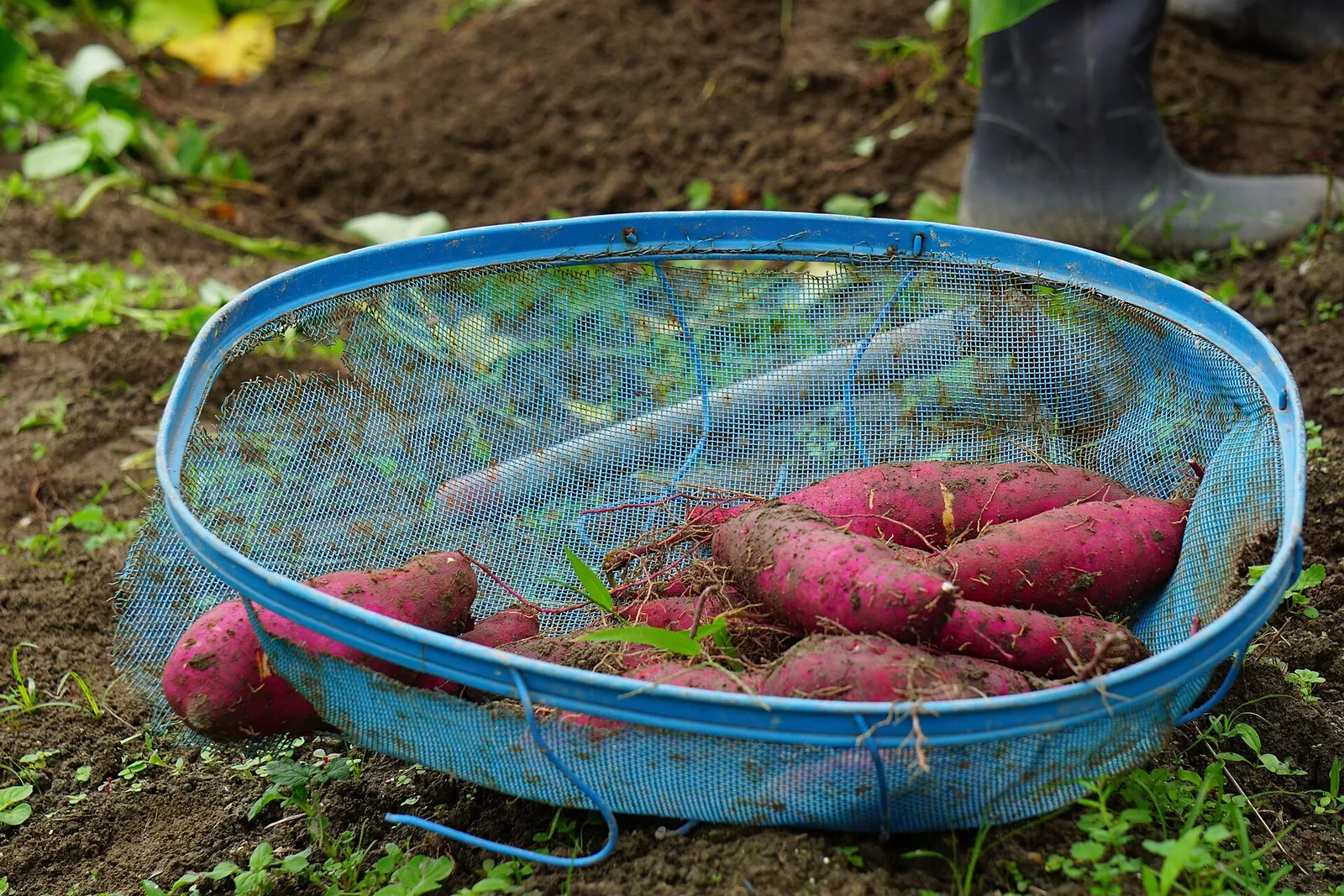
Lay the roots in a soft-lined box or basket, not a hard bucket. Maryland Extension suggests lining containers with rags or soft material to keep the skins from scratching. Every nick is a place decay can start.
Set the dug roots in a shady, dry spot while you finish. Do not leave them in the sun, which can scald the skins.
Curing and storage (this is the part that matters)
Curing is the step that separates a good harvest from a wasted one. Fresh-dug sweet potatoes are starchy and bland, and their cut skins are open to rot. Curing fixes both.
Curing heals the nicks in the skin and turns starch into sugar, so the roots get sweeter and store for months.
Cure for about 10 days at roughly 80 to 85°F with high humidity. University of Maryland Extension gives about 10 days at 80–85°F and 85–90 percent humidity. Iowa State lists 80 to 85°F at 90 to 95 percent humidity for about a week. Alabama Extension runs warmer and shorter, at 85°F for 4 to 7 days. The common thread is warm and humid, for one to two weeks.
No curing room? A warm spot works. Maryland notes you can partially cure roots by leaving them in a garage or covered outdoor spot for a week or so, which works best for an early-fall harvest when it is still warm out.
After curing, move to cool storage:
| Stage | Temperature | Humidity | Time |
|---|---|---|---|
| Curing | ~80–85°F | 85–95% | ~7–14 days |
| Storage | ~55–60°F | 85–90% | 4–6 months |
Store cured roots at about 55 to 60°F in a dark, dry place like a closet or basement. Below about 55°F you risk chilling injury and off-flavors. Above 60°F they start to sprout. Wrap them in newspaper or set them in a lined box so air still moves around them.
Never refrigerate sweet potatoes. Purdue University Extension says it plainly: sweet potatoes are subject to chilling injury, so keep them out of the fridge. The cold causes hard centers, off-flavors, and faster decay.
Common mistake
The four ways gardeners lose a good crop:
- Skipping the cure. Uncured roots stay bland and starchy and rot in weeks instead of keeping for months.
- Refrigerating them. Below ~54°F brings chilling injury, hard centers, and decay.
- Harvesting after a hard freeze. Decay in frozen vines moves down into the roots fast. Dig the same day.
- Rough handling. Thin skins bruise and tear. Every nick is a doorway for rot.
Pro tip
Harvest in the morning of a dry day and let the roots air-dry in the shade for an hour or two before you move them. Drier skins handle better and bruise less, which gives the cure a clean start. Then get them into the warm, humid cure within a day.
Where sweet potatoes sit among fall crops
Sweet potatoes share a harvest window with the other big fall diggers. Regular potatoes also wait on the foliage dying back, covered in when to harvest potatoes. Winter squash and pumpkins want a hard rind before frost. The shared rule is simple: get them in before a hard freeze, then handle and store them right.
Spacing matters too, since crowded slips make smaller roots. Sweet potatoes want about 12 inches apart in rows 36 inches apart. Run your bed through the plant spacing calculator to see how many slips fit before you plant next spring.
Your next step
Count your days from transplant, watch for the vines to yellow, and dig before the first frost on a dry day. Then cure for about 10 days at 80 to 85°F and store at 55 to 60°F, never in the fridge.
Planning next year's patch? Open the plant spacing calculator to lay out your slips and get the biggest roots from the bed you have.
How many plants fit your bed
When you replant, size the bed first. Run your dimensions through the calculator to see how many plants fit in square, triangular, and square-foot layouts.
Try it — Plant Spacing Calculator
Full calculatorExtra to cover losses (10% is typical).
You can plant
32plants
- Per row
- 8
- Rows
- 4
- Buy (incl. spare)
- 36 plants
Common questions
How do I know when sweet potatoes are ready to harvest?
Count the days first. Most varieties are ready about 90 to 120 days after transplanting. The clearest visual cue is the vines yellowing, and a cool fall slows growth, so dig before the first frost. To be sure, test-dig one hill and check the root size.
Can you harvest sweet potatoes after a frost?
A light frost that kills only the tops is fine if you dig within a day or two, because decay in dead vines can move down into the roots. After a hard freeze, harvest immediately. Frost can damage roots sitting near the surface, so do not leave them in cold soil.
Do sweet potatoes need to be cured before eating?
Yes, for the best flavor and storage. Curing heals nicks in the skin and turns starch into sugar, so the roots get sweeter. Cure about 10 days at roughly 80 to 85°F with high humidity, then store cool. You can eat them fresh, but cured ones taste better and keep for months.
How long do sweet potatoes take to grow?
About 90 to 120 days from transplanting, with some varieties reaching 120 days or a bit more. University of Maryland Extension lists a range of 85 to 120 days. Warm soil speeds them up and a cool fall slows them down, so use the days as a guide and confirm with a test dig.
Why should you not refrigerate sweet potatoes?
Sweet potatoes come from the tropics and suffer chilling injury below about 54°F. The fridge is too cold. It causes off-flavors, hard centers, and faster decay. Store cured roots at about 55 to 60°F in a dark, dry spot like a closet or basement instead.
Sources
Agronomic claims in this guide are checked against these primary sources.
- Growing Sweet Potatoes in a Home Garden — University of Maryland Extension
- Time to Harvest Sweet Potatoes — Purdue University Consumer Horticulture
- How do I harvest and store sweet potatoes? — Iowa State University Extension
- Harvesting and Curing Sweet Potatoes — Alabama Cooperative Extension System
Keep reading
When to Harvest Potatoes (Signs They're Ready)
Dig new potatoes around flowering, about 6 to 8 weeks after planting. Wait for maincrop potatoes until the tops die back and the skin sets, roughly 90 to 120 days.
Read →When to Harvest Butternut Squash (Signs It's Ready)
Butternut squash is ready about 100 to 110 days from planting, when the rind turns deep tan, hardens past a thumbnail, and the stem goes corky and dry.
Read →When to Harvest Pumpkins (Signs They're Ready)
Pumpkins are ready about 90 to 120 days from planting, when the color is deep and even, the rind shrugs off a thumbnail, and the stem turns hard and woody.
Read →When to Plant Zucchini (Frost + Soil Temp Timing)
Plant zucchini after your last spring frost, once the soil hits at least 60 F (ideally 65 to 70 F). Direct-sow seeds 1/2 to 1 inch deep, or set out transplants started 2 to 4 weeks earlier. Warm zones get a second fall crop.
Read →When to Plant Tomatoes (Frost + Soil Temp by Zone)
Set tomato transplants out 1 to 2 weeks after your last spring frost, once soil hits at least 60 F. Start seeds indoors 6 to 8 weeks before that frost date. Cold soil stalls them, so wait for warmth.
Read →When to Plant Swiss Chard (Spring and Fall Timing)
Plant swiss chard 2 to 4 weeks before your last spring frost, once the soil hits 40°F. Sow again 3 to 4 weeks before the first fall frost. Seeds go half an inch to an inch deep.
Read →